Complete Blood Counts
Order basic CBCs or CBCs with reticulocytes for routine, sick-patient, and follow-up workups.
Submit CBCs, reticulocyte counts, platelet testing, coagulation panels, PT, aPTT, fibrinogen, and related hemostasis tests through B&L.
Order basic CBCs or CBCs with reticulocytes for routine, sick-patient, and follow-up workups.
Request pathologist review when CBC findings or blood cell morphology need additional evaluation.
Submit manual platelet counts and listed platelet antibody testing when clinically indicated.
Order coagulation panels, PT, and aPTT for initial evaluation of clotting function.
Review fibrinogen, thrombin time, D-dimer, antithrombin, Protein C, and related assays.
Submit von Willebrand factor testing as part of a targeted bleeding-disorder workup.
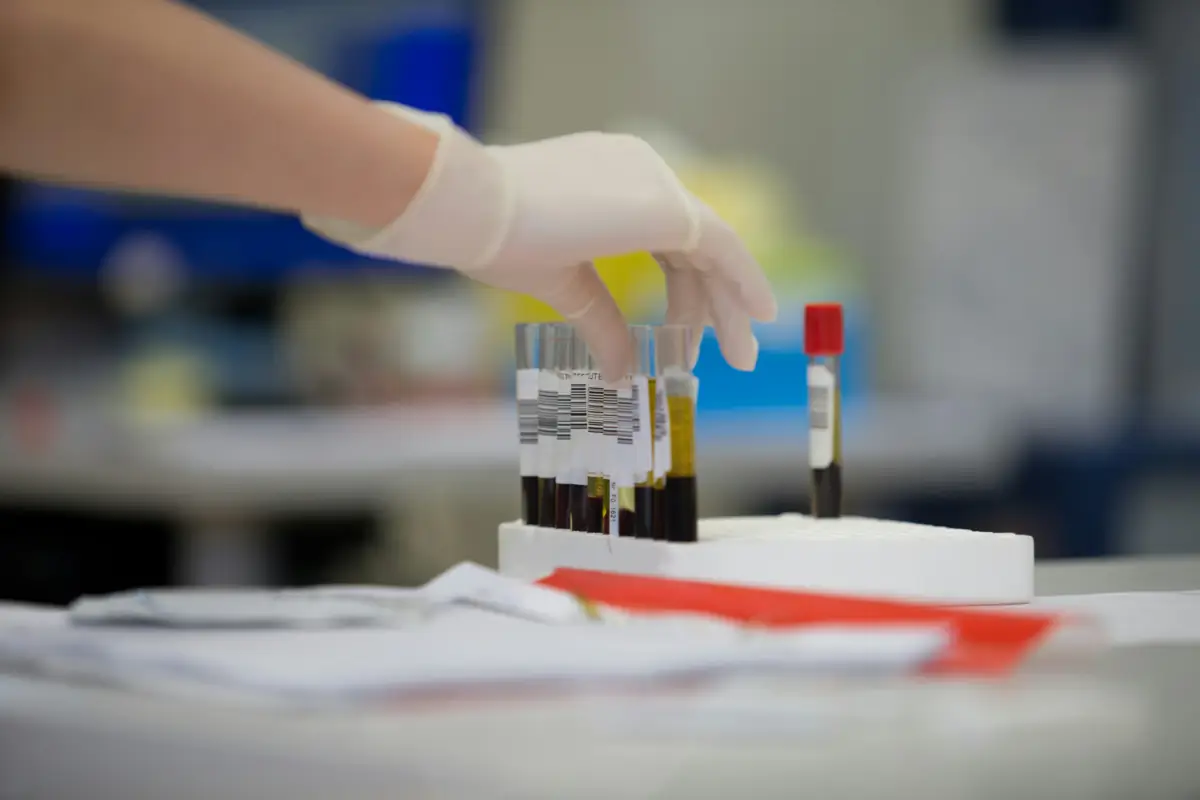
These tests support routine blood cell assessment, anemia and platelet workups, and evaluation of suspected bleeding or coagulation disorders.
A routine or sick-patient workup requires a CBC.
Anemia assessment needs a CBC with reticulocytes.
A low or questionable platelet count needs manual review.
Bleeding, bruising, or prolonged clotting raises a hemostasis concern.
A procedure or clinical history calls for coagulation screening.
Abnormal blood cell findings need pathologist review.
Hematology and coagulation results depend on the correct tube, complete fill, prompt mixing, and test-specific processing.
Gently invert EDTA tubes immediately after collection. Even small clots can alter cell and platelet counts and may require recollection.
Coagulation testing depends on the correct blood-to-citrate ratio. An underfilled blue-top tube can produce unreliable clotting times.
Atraumatic venipuncture helps reduce clotting, hemolysis, and tissue-factor contamination that can affect hematology or coagulation results.
Some assays require separated citrate plasma and specific storage conditions. Follow the B&L test menu for processing and shipment.
Review B&L testing for CBCs, reticulocytes, platelets, PT, aPTT, fibrinogen, thrombin time, D-dimer, antithrombin, Protein C, and von Willebrand factor.
Use the B&L test menu to confirm tube type, fill volume, processing, storage, test code, and turnaround details before collection.
Search CBC, platelet, PT, aPTT, or coagulation tests| Test | Code | Turnaround |
|---|---|---|
| Antithrombin III 5-7 Days | 355 | |
| aPTT (Partial Thromboplastin Time) 1 Day | 351 | |
| Basic CBC 1 Day | 3005 | |
| CBC with Reticulocytes 1 Day | 3000 | |
| View all 16 related tests | ||
Many practices save 15-30% a month on lab costs. Share your current lab setup, and B&L will review pricing, logistics, PIMS fit, contract timing, and next steps.
B&L lists basic CBCs, CBCs with reticulocytes, pathologist CBC review, manual platelet counts, platelet antibody testing, and follow-up whole-blood submissions.
The test menu includes coagulation panels, PT, aPTT, fibrinogen, thrombin time, D-dimer, antithrombin III, Protein C activity, and von Willebrand factor testing.
Coagulation assays require the proper ratio of blood to sodium citrate. Underfilling changes that ratio and can affect clotting-time results.
Contact B&L before shipping when possible. A clotted EDTA sample may not provide a valid CBC or platelet count and may need to be recollected.